

Most spring prep guides focus on what to plant and when to fertilize. What they skip over is the other side of that equation: what the land itself is doing while you’re planning. For properties in Flemington, NJ, where the town’s position near the edge of the Sourland Mountain foothills means clay-heavy soils and natural drainage corridors run through many residential and rural lots, and across Hunterdon County, June is the month when woody brush, invasive shrubs, and opportunistic vines shift from manageable to genuinely difficult. Brush clearing hunterdon county nj requests peak right now for a reason, and it has everything to do with how this specific landscape behaves once summer humidity arrives. If you’ve got a field edge, a back slope, or a neglected tree line on your property, here’s what’s actually happening out there.
Site planning is stronger when it accounts for local soil and runoff patterns, so resources like the USDA Web Soil Survey and EPA stormwater guidance can help frame the right questions before work begins.
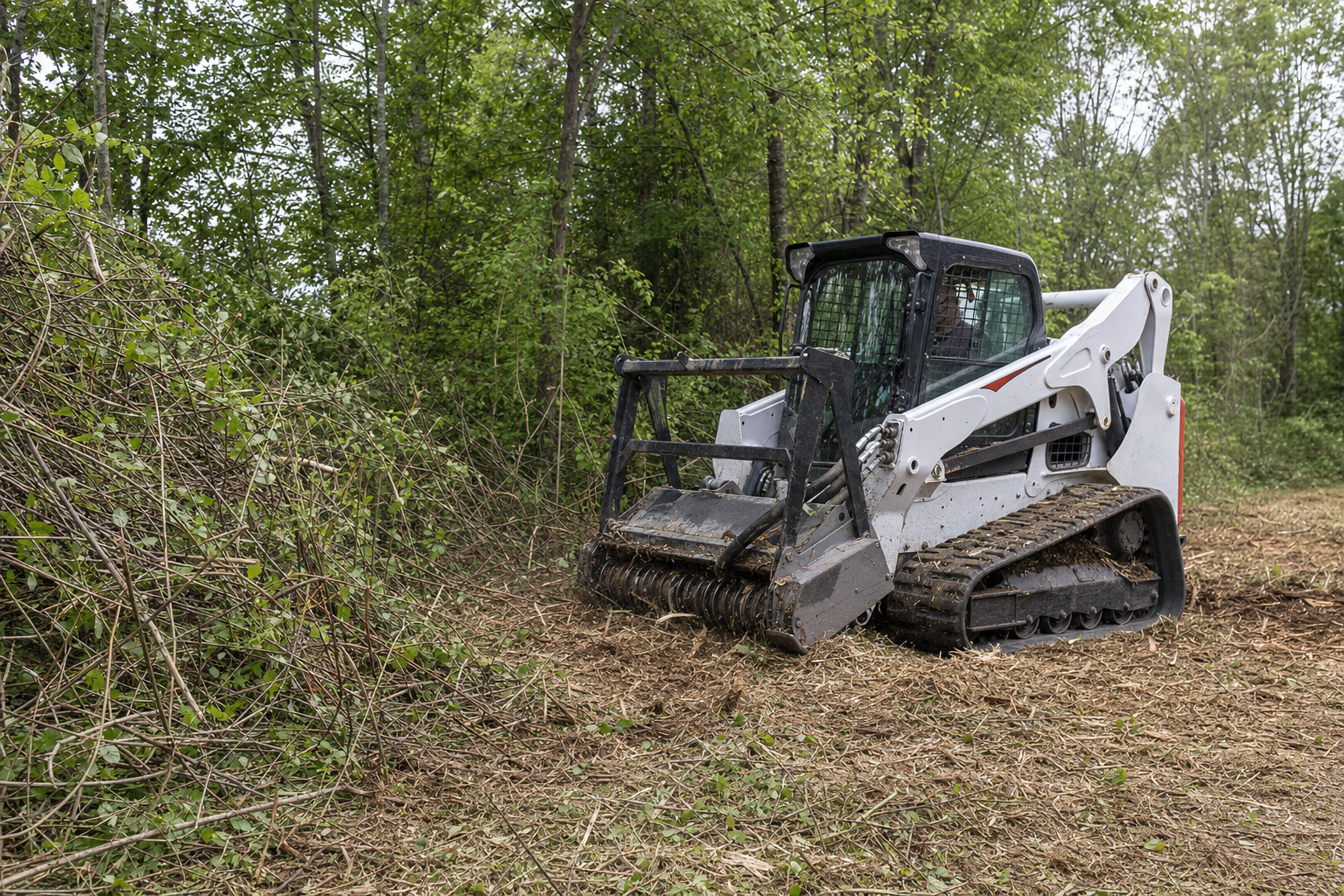
Hunterdon County’s Terrain Creates Natural Brush Corridors
Hunterdon County sits in the Piedmont region of New Jersey, where the flat coastal plain transitions into rolling hills and ridgelines. That topography matters more than most people realize. Properties here often include slope breaks, drainage swales, and low-lying wet zones that don’t get mowed regularly. Those are exactly the conditions where woody brush establishes fastest.
The soils across much of the county, including the Raritan Township and Readington Township areas, tend toward heavier clay content with moderate organic matter. Clay soils hold moisture longer after rain, which benefits shallow-rooted invasive species disproportionately. A field or tree line that looked fine in April can develop four feet of new growth by late June, particularly along the county’s many seasonal stream corridors.
The terrain also creates wind shadow zones, where seeds from neighboring properties or wooded areas accumulate. Properties near the South Branch of the Raritan River regularly deal with dense woody regrowth along their lower edges, even on otherwise well-maintained land. The geography funnels seed dispersal in ways that make certain spots on a property almost magnetically prone to brush.
The Species Behind Most Brush Clearing Hunterdon County NJ Work
Not all brush is the same, and knowing what you’re dealing with changes how clearing needs to be approached. These are the species we encounter most often on Hunterdon County properties this time of year.
Multiflora rose is arguably the most common problem plant in this region. Introduced as a wildlife hedge plant decades ago, it’s now classified as an invasive species in New Jersey. It spreads aggressively through bird-dispersed seeds and forms dense, thorny thickets that are nearly impenetrable once established. A single plant can produce a million seeds per year.
Autumn olive is another nitrogen-fixing shrub that thrives on disturbed soils and field edges. It grows quickly, outcompetes native vegetation, and is particularly common along roadsides and property boundaries throughout the county.
Oriental bittersweet is a vine that climbs trees and shrubs, eventually girdling and killing them. It’s especially aggressive on wood edges and is extremely difficult to remove without cutting the root crown.
Ailanthus altissima, commonly called tree of heaven, sprouts from root fragments and stumps and can grow several feet in a single season. It’s prevalent on disturbed ground near older structures and farm remnants, which are common on Hunterdon County’s many rural and semi-rural properties.
Japanese barberry rounds out the list. Dense, spiny, and shade-tolerant, it spreads into woodland understories and is a known habitat for black-legged ticks, a real concern for anyone working or spending time on these properties.
Why Summer Timing Matters More Than Most Homeowners Expect
June sits in a narrow window. The ground is workable, the canopy hasn’t fully closed in, and woody plants are in active growth, which means cut stumps respond well to treatment before they resprout. Wait until August and you’re dealing with fully hardened stems, dense overhead canopy, and plants that have already set seed for the following year.
Hunterdon County averages around 47 inches of rainfall annually, distributed fairly evenly across the seasons. June tends to bring regular rain events that accelerate growth. Combined with the county’s position in USDA Hardiness Zone 6b, which means warm summers and cold but not extreme winters, conditions here favor fast-establishing woody species that can handle both seasonal extremes.
This is why brush clearing hunterdon county nj requests tend to cluster in late spring and early summer. Homeowners who cleared a field edge last fall are often surprised to find it needs attention again by June. That’s not a failure of the previous clearing work. It’s simply how these species behave in this climate.
For properties where clearing connects to a larger project, installing a paver patio or retaining wall, establishing a new lawn area, or creating defined planting beds, the clearing phase is foundational. Skipping it or doing it incompletely creates problems that show up months later. Our excavation work on properties across the county regularly involves removing root systems from prior brush that wasn’t fully addressed.
What a Proper Clearing Process Actually Involves
Surface cutting alone, by mowing or hand clearing, rarely resolves a brush problem. Most of the species listed above resprout vigorously from root crowns. Effective clearing involves cutting at or near the base, removing or treating the stump, and in many cases, a follow-up visit six to eight weeks later to address regrowth before it hardens.
On sloped properties, which are common across Readington Township and Raritan Township, clearing also requires attention to erosion. Removing established brush on a slope exposes soil that needs to be stabilized quickly, through seeding, mulch, or a planned planting. Our landscaping work often begins right where clearing ends, because bare ground on a Hunterdon County slope doesn’t stay bare for long.
If you’ve been watching a field edge or back slope creep closer to your usable yard, June is genuinely the right time to address it. You can read more about what the brush hogging process looks like on a single property in our Flemington brush hogging guide, and if your property has drainage concerns connected to that overgrown area, our drainage and grading post covers how those two issues often connect. The practical takeaway: clearing done now, before late-summer seed set and stem hardening, is significantly more effective and requires less follow-up than the same work done in September. The plants on your property know what month it is. It helps to know it too.
If you’d like to talk through what’s on your property, reach out to our team and we can take a look.
